


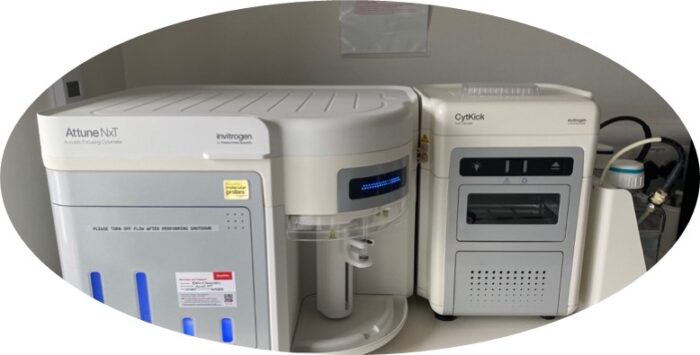
The Invitrogen Attune™ NxT Flow Cytometer is a high-throughput, benchtop flow cytometry platform designed for quantitative single-cell analysis in suspension. The system enables rapid, multiparametric characterisation of heterogeneous cell populations based on size, granularity, and fluorescence-labelled molecular markers.
The instrument is equipped with three excitation lasers (violet, blue, and red) and supports multi-colour fluorescence detection (up to ~10 colours depending on configuration), enabling simultaneous analysis of multiple cellular parameters. Advanced optical design and sensitive detectors provide reliable discrimination of complex cell populations and low-abundance signals.
A key feature of the system is its acoustic focusing technology, which uses ultrasonic waves to precisely align cells within the flow stream. This enables high sensitivity and significantly increased acquisition speed-up to 10× faster than conventional flow cytometers-while maintaining data quality and enabling detection of rare events.
The system is also equipped with a CytKick autosampler, allowing automated high-throughput sample processing in multiwell plate formats, supporting efficient analysis of large sample sets and screening workflows.
The platform features an intuitive and user-friendly software interface, facilitating efficient experimental setup, data acquisition, and analysis with minimal training requirements.
Key Capabilities
- High-throughput single-cell analysis with acoustic focusing technology
- Multi-parameter fluorescence detection (multi-colour analysis)
- Measurement of cell size (FSC), granularity (SSC), and molecular markers
- Rapid acquisition with high sensitivity and rare event detection
- Automated sample handling using CytKick autosampler (plate-based workflows)
- Flexible workflows for small-volume and dilute samples
- User-friendly operation and data analysis software
Typical Applications
The system supports a wide range of flow cytometry applications, including:
- Cell cycle analysis (e.g., propidium iodide staining)
- Cell proliferation assays (e.g., CFSE)
- Apoptosis analysis (e.g., Annexin V / PI)
- Reactive oxygen species (ROS) detection
- Mitochondrial activity assays (e.g., MitoTracker)
- Immunophenotyping (cell surface marker analysis)
- Detection and analysis of extracellular vesicles (EVs)