


RegenHU 3DDiscovery™ Evolution
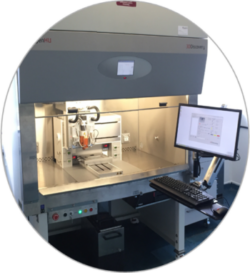
The RegenHU 3DDiscovery™ Evolution is a multi-material bioprinting platform designed for advanced biofabrication of thermoplastics, hydrogels, and cell-laden materials. The system is equipped with three independently controlled printheads: two hydrogel extrusion modules and one thermoplastic extruder capable of temperatures up to 250 °C. Independent temperature control of both printheads and print bed (4-30 °C range) enables processing of temperature-sensitive biomaterials and live cells.
The thermoplastic extrusion module supports nozzle diameters down to 500 µm, allowing fabrication of fine structural features. The system is housed within a Class II biosafety cabinet to ensure sterile printing conditions and includes an integrated UV curing module for in situ hydrogel crosslinking. A time-pressure dispensing mechanism provides precise control of material deposition.
Key Capabilities:
- Multi-material biofabrication combining thermoplastics and hydrogels
- Printing of cell-laden constructs under sterile conditions
- Temperature-controlled processing for sensitive biomaterials
- Fabrication of fine structural features (<500 µm)
- In situ UV crosslinking of photocurable hydrogels
- Controlled pressure-based extrusion for reproducible material deposition
CELLINK BIO X6 3D Bioprinter
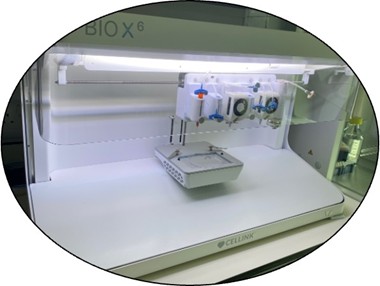
The CELLINK BIO X6 is a high-flexibility, multi-material 3D bioprinting platform equipped with six modular printheads for simultaneous or sequential deposition of diverse materials. The system supports extrusion-based bioprinting of thermoplastics, hydrogels, cell-laden bioinks, and other biomaterials, enabling the fabrication of complex, physiologically relevant constructs.
Precise thermal control is available across the platform. The thermoplastic printhead supports temperatures up to 250 °C, enabling processing of high-melting-point polymers. Five pneumatic extrusion printheads are available for hydrogel and cell-laden bioink printing, with two temperature-controlled pneumatic printheads operating within a 4–37 °C range, allowing handling of temperature-sensitive biomaterials. The print bed temperature can be regulated between 4 °C and 35 °C, supporting controlled gelation and material stabilisation during fabrication.
The BIO X6 also incorporates advanced environmental control through Clean Chamber™ technology, including HEPA H14 filtration, UV-C sterilisation, and positive air pressure, facilitating sterile bioprinting of living cells without the need for an external biosafety cabinet.
Additional features such as automated calibration, intuitive control software (DNA Studio), and support for coaxial printing modalities further enhance experimental flexibility and reproducibility.
Key Capabilities
The system supports:
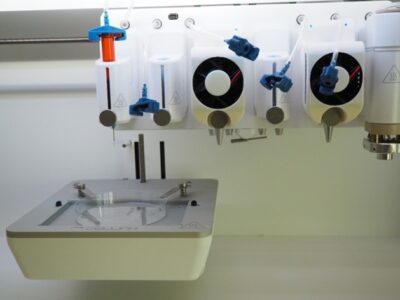
- Six modular printheads enabling complex multi-material and multi-cellular construct fabrication
- One thermoplastic printhead with temperatures up to 250 °C for high-melting-point polymer processing
- Five pneumatic extrusion printheads, including two temperature-controlled modules (4-37 °C) for cell-laden and temperature-sensitive bioinks
- Temperature-regulated print bed (4–35 °C) to support controlled gelation and structural stability during printing
- Clean Chamber™ sterile printing environment with HEPA H14 filtration and UV-C sterilisation
- Integrated UV photocuring with multiple wavelength modules (365 nm, 405 nm, 485 nm, 520 nm)
- Coaxial and mixing printing capabilities for advanced scaffold and tissue architectures
- Automated calibration and intuitive software control for reproducible and streamlined workflows