


JPK Nanowizard 3
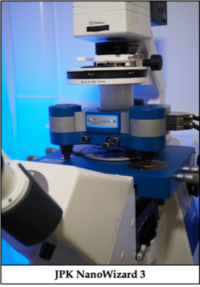
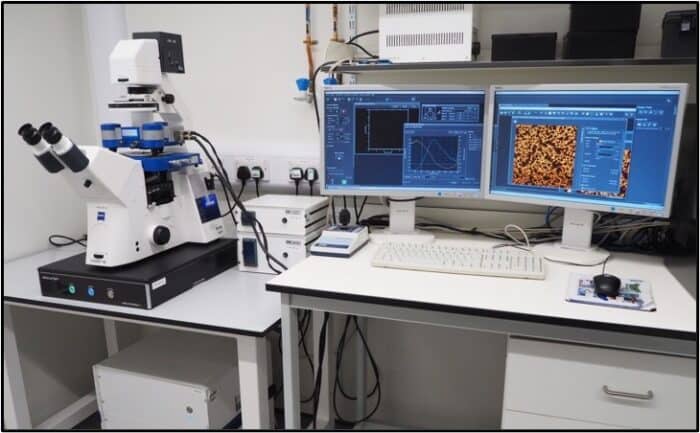
The JPK NanoWizard® 3 atomic force microscope is mounted on an inverted Zeiss Axio Observer optical microscope, enabling precise sample positioning and correlative brightfield imaging during nanoscale measurements.
The system offers a large scan range (up to 100 µm × 100 µm), high force sensitivity, and excellent mechanical stability for quantitative nanomechanical analysis in both air and liquid environments. A temperature-controlled stage supports experiments under physiologically relevant or variable thermal conditions, making the platform particularly well suited for soft matter, biomaterials, polymer systems, and live-cell studies.
The modular configuration allows seamless switching between high-resolution imaging and quantitative force measurement modes.
 Available measurement modes:
The system supports a wide range of high-resolution imaging and quantitative force measurement modes, including:
- Contact Mode Imaging
- Intermittent Contact (Tapping) Mode Imaging
- Quantitative Imaging (QI™) Mode for nanomechanical mapping
- Force Spectroscopy
- Force-Distance Curve Acquisition
- Force Mapping for spatially resolved mechanical analysis
- Single-Cell Force Spectroscopy (SCFS)
These modes enable detailed characterisation of surface topography, elasticity, adhesion, and cell-substrate or cell-cell interactions across a broad range of biological and material systems.
Nanosurf DriveAFM
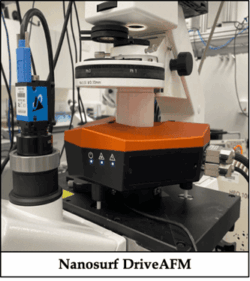
The Nanosurf DriveAFM is integrated with an inverted Zeiss Axio Observer microscope equipped with fluorescence imaging, enabling correlative mechanical and optical measurements. The system can also be utilised in combination with fluorescence lifetime imaging (FLIM) via the Horiba FLIMera, allowing correlation of nanomechanical properties with fluorescence lifetime-based biochemical information.
The system features a dual-laser configuration comprising a standard optical beam deflection detection laser and a photothermal CleanDrive excitation laser. CleanDrive photothermal actuation provides direct cantilever excitation without mechanical coupling to the scanner, resulting in stable, low-noise, and high-resolution imaging, particularly advantageous for soft biological samples and liquid environments.
The instrument supports advanced nanomechanical characterisation and force-based measurements. A motorised, temperature-controlled stage with fluidic compatibility, including FluidFM options, enables live-cell and single-cell experiments under controlled environmental conditions.
In addition, FLIM measurements are enabled through the Horiba FLIMera system, a TCSPC-based fluorescence lifetime imaging module with 473 nm excitation. This allows rapid acquisition of fluorescence lifetime data from live samples, supporting the study of dynamic biological processes and providing complementary functional information alongside AFM measurements.
 Available measurement modes:
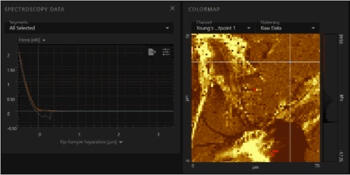
The system supports a broad range of imaging and quantitative nanomechanical measurement modes, including:
- Static Mode Imaging
- Tapping (Dynamic) Mode Imaging
- Off-Resonance WaveMode
- Force Spectroscopy
- Force–Distance Curve Measurements
- Nanomechanical Mapping
- Single-Cell Force Measurements (with FluidFM)
These modes enable precise characterisation of surface topography, mechanical properties, and cell-level interactions, with particular advantages for soft biological samples and measurements in liquid. Combined with fluorescence and FLIM capabilities, the system enables multimodal analysis linking mechanical properties with molecular and biochemical dynamics.