

Anton Paar MCR 302e
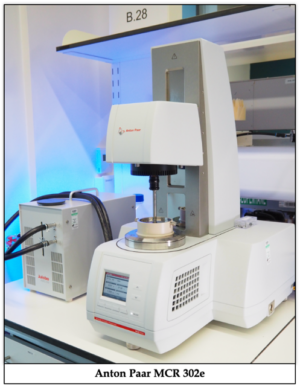
The Anton Paar MCR 302e Modular Compact Rheometer is a high-precision rotational rheology platform designed for detailed mechanical characterisation of soft materials.
The instrument incorporates a Peltier-controlled temperature system for accurate and stable thermal regulation across a wide experimental range. A selection of interchangeable measuring geometries, including cone-and-plate, parallel plate, and concentric cylinder configurations, provides flexibility for different sample types and testing protocols. The system also includes a glass measuring plate that enables in situ UV curing experiments, allowing real-time monitoring of polymerisation and gelation processes.
With sensitive torque control and advanced oscillatory testing capabilities, the platform supports reliable measurements of viscosity, viscoelastic properties, and time-dependent mechanical behaviour.
The system is particularly suited for hydrogels, bioinks, polymer solutions, and other soft biomaterials under physiologically relevant or material processing conditions.
Key Capabilities
The system supports a wide range of rheological tests, including:
- Viscosity measurements (shear-dependent viscosity)
- Temperature-dependent measurements
- Creep tests
- Stress relaxation tests
- Strain (amplitude) sweeps
- Frequency sweeps
- Gelation kinetics (time sweeps)
- Recovery tests
- Compression tests
RheoLab™ (DWS RheoLab – LS Instruments)
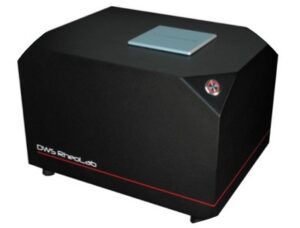
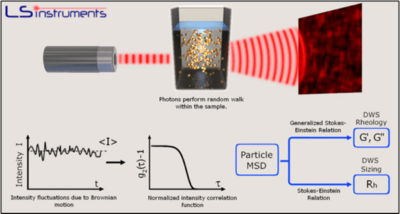
The DWS RheoLab™ (LS Instruments) is an optical rheometer based on Diffusing Wave Spectroscopy (DWS), enabling non-contact microrheological characterisation of complex fluids and soft materials. Unlike conventional rheometry, the system probes the Brownian motion of embedded tracer particles to quantify viscoelastic properties across a broad frequency range without applying external mechanical stress.
This contact-free approach allows measurements in sealed sample cells using small volumes, making it particularly suitable for fragile, highly viscous, turbid, or concentrated systems. The platform is well suited for hydrogels, emulsions, suspensions, protein solut ions, polymers, and other complex fluids, and supports long-term stability and shelf-life studies with minimal sample disturbance.
Key Capabilities
The system supports:
- Optical, contact-free microrheology using DWS
- Quantitative access to elastic and viscous responses
- Extended frequency range beyond conventional rotational rheometry
- Small sample volume measurements in sealed cells
- Characterisation of fragile, turbid, or highly concentrated materials
- Microstructural and texture analysis of complex fluids